
Doug Isenberg Speaks at 'Imminent Domains' Webinar

Doug Isenberg is one of two speakers at a webinar titled “Imminent Domains: Opportunities and Challenges for Trademark Owners After ICANN Reveals the New gTLD Applications.”

The webinar, organized by Alt Legal, will take place on November 12, 2026. Doug will be joined by Matt Serlin, senior director of domain management at Abion.

The webinar will cover the latest developments in the ongoing expansion of the domain name system, the opportunities and challenges facing brand owners, and the practical steps that trademark owners and others should be taking today to prepare for tomorrow, as well as for years to come. Topics include:

  • What the revealed string landscape tells us about the challenges and opportunities ahead

  • What trademark owners, applicants and others need to know about filing objections against new gTLD applications

  • What the expanded namespace means for brand owners and portfolio managers

  • How to approach monitoring and enforcement in an expanded ecosystem

  • What rights protection mechanisms exist and practical steps brands should take

  • How domain abuse is likely to evolve, and why the UDRP and URS will remain among the most effective enforcement tools

The webinar is pending CLE approval.
Doug Isenberg Appointed by WIPO as Panelist for ICANN's New gTLD Objections

Doug Isenberg of The GigaLaw Firm has been appointed by the World Intellectual Property Organization (WIPO) as a panelist to consider objections filed pursuant to the Internet Corporation for Assigned Names and Numbers’ (ICANN’s) 2026 New gTLD (generic top-level domain) Program.

Specifically, WIPO has included Isenberg on its roster of panelists eligible to decide disputes filed under two procedures:

  • Legal Rights Objections allow all rights holders to file objections against new gTLD applications if they believe that an applied-for string “infringes their existing legal rights.”

  • String Confusion Objections allow existing gTLD and ccTLD operators, as well as applicants for new gTLDs, to file objections against new gTLD applications if they believe that an applied-for string is “similar visually, aurally, or in meaning” to an existing gTLD or applied-for string.

Isenberg, a panelist for all five ICANN-approved service providers under the Uniform Domain Name Dispute Resolution Policy (UDRP), served as a panelist in the 2012 round of new gTLD applications. He also represented applicants and objectors in the 2012 round.

ICANN recently reported that 1,616 applications for new gTLDs will proceed in the 2026 program and that it expects to publish the list of applied-for strings no later than October 14, 2026, at which time it will also include timelines for filing objections.

Doug Isenberg Recognized in 'Best Lawyers' for Technology Law 2027

Doug Isenberg has been recognized by his peers in the 2027 edition of The Best Lawyers in America for his work in technology law.

“Recognition in Best Lawyers reflects the confidence and respect of fellow lawyers who know the work and the profession,” the publication said. “Recognition is determined through our peer-review process, not through paid placement or self-nomination, and no fee is required to be considered or recognized.”

Attorneys such as Isenberg who are listed in the area of technology law “have demonstrated expertise in both intellectual property and commercial law, as well as knowledge of industry best practices,” according to Best Lawyers.

Isenberg’s practice at The GigaLaw Firm is focused on helping companies protect their brands on the Internet, especially in the area of domain name disputes. He regularly represents trademark owners and domain name registrants in proceedings under various policies designed to combat cybersquatting, including the Uniform Domain Name Dispute Resolution Policy (UDRP).

The World Intellectual Property Organization (WIPO) has recognized Isenberg as one of the most active attorneys in UDRP cases.

In addition to representing parties in domain name dispute proceedings, Isenberg also serves as a panelist for all five of the ICANN-accredited UDRP service providers: WIPO, the Forum, the Czech Arbitration Court (CAC), the Asian Domain Name Dispute Resolution Centre, and the Canadian International Internet Dispute Resolution Centre (CIIDRC).

The Best Lawyers recognitions for 2027 “reflect the highest level of selectivity in the award’s history,” the publication said.

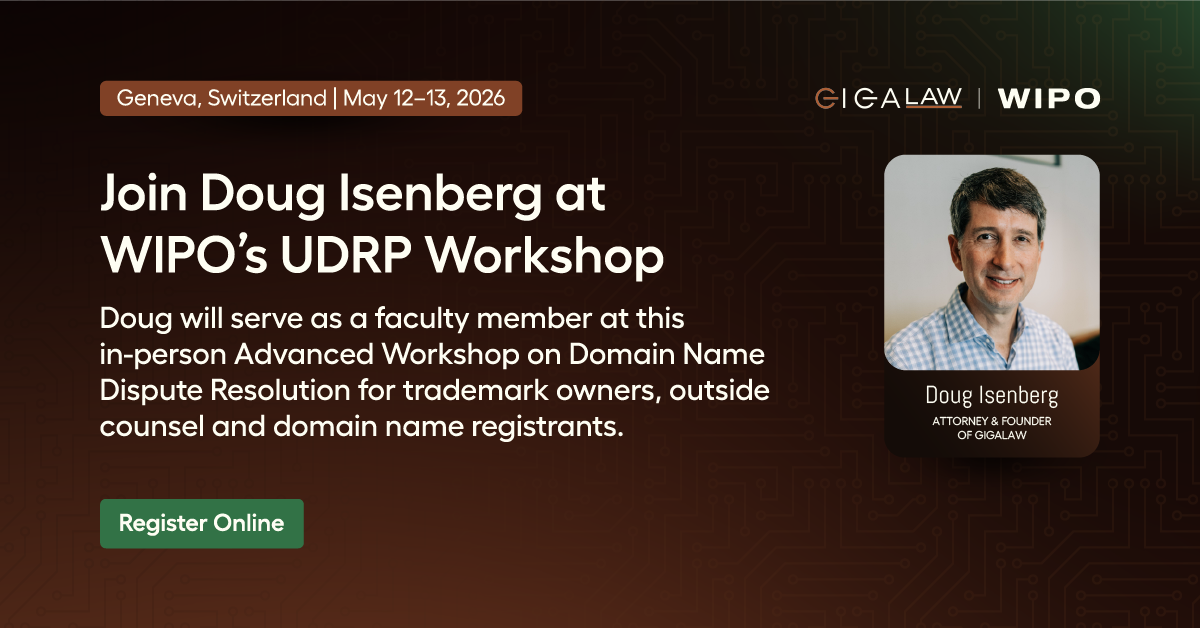
Doug Isenberg Joins Faculty for WIPO's UDRP Workshop

Doug Isenberg will participate as an in-person faculty member for the Advanced Workshop on Domain Name Dispute Resolution organized by the World Intellectual Property Organization (WIPO). The event will take place in Geneva on May 12-13, 2026.

Doug will join WIPO staff members and other domain name dispute panelists from around the world at this program, which focuses on the Uniform Domain Name Dispute Resolution Policy (UDRP).

WIPO says that the “target audience for this Workshop includes potential case parties, namely: trademark owners, outside counsel, and domain name registrants. Registrars and ccTLD administrators also attend the Workshop to increase their knowledge of UDRP decisions and case administration processes, as well as current issues in the DNS more generally. Participants should have a basic understanding of the DNS and trademarks.”

In addition to presentations, the two-day program will include practical breakout sessions and discussions between participants and instructors.

For more details or to register for the workshop, click here.

Doug Isenberg Quoted by Westlaw Today as 'Domain Expert'

Attorney Doug Isenberg, founder of The GigaLaw Firm, was quoted in an article from Thomson Reuters Westlaw Today, “Domain expert opines on why L'Oreal moved to cancel domains en masse.”

The article examines a recent decision under the Uniform Domain Name Dispute Resolution Policy (UDRP), in which the panel ordered the cancellation of 705 domain names in a cybersquatting case filed by L’Oreal.

The article says:

L'Oreal sought a mass cancellation, an option that only about 1% of those filing UDRP complaints seek, according to GigaLaw's Domain Dispute Digest, a quarterly publication by attorney Doug Isenberg.

Isenberg speculated that the exceptionally large number of domains contributed to L'Oreal's decision.

"Some companies have become very mindful of the sizes of their domain name portfolios, which require annual renewal fees paid to their registrars, so adding hundreds of domain names in a single batch could be seen as a considerable expense not worth incurring," he said.

"On the other hand, I almost always advise my clients to seek the transfer, not cancellation, of domain names in UDRP cases to avoid the real possibility that another cybersquatter might register a canceled domain name, at which time a trademark owner could choose to file a second UDRP complaint for the same domain name, which would be much more expensive than if the trademark owner had the domain name transferred in the first place."

Isenberg noted that the current form of the UDRP does not allow for "true" cancellations, meaning a panel can only remove a disputed domain from the current registrant's control, not prohibit that registrant or another from re-registering the domain.

"WIPO and the Internet Commerce Association recently said that true cancellation is something that ICANN should consider as a remedy in any review of the UDRP, and I would see it as a welcome change," he said, referring to the Internet Corporation for Assigned Names and Numbers, the organization that adopted the UDRP in 1999 to streamline the resolution of domain disputes.